
Underwriter hub
Lending / loan platform
How can we better support internal underwriting teams to streamline the customer journey into the bank and ensure customers are efficiently matched with the products that best meet their needs?
Project overview
The Underwriter hub is a centralised environment where customer applications submitted via brokers are processed for loans and mortgages. It enables underwriters to review, verify, and assess applications in order to evaluate lending risk. This includes analysing credit history, income, existing debt, and property value to determine whether an application should be approved, declined, or adjusted, while ensuring full compliance with financial regulations and lender policies.
The Underwriter hub also serves as a comprehensive source of supporting information, allowing underwriters to build a complete and accurate view of each customer. This ensures that all relevant factors and potential scenarios are considered before a lending decision is made. The system must not only securely store this information, but also allow it to be easily added, edited, or removed. In addition, the solution must be designed and maintained within the Pega CMS platform.
Research
Twice-weekly sessions were held with the underwriting team to gain a clear understanding of their needs as the platform was developed in close collaboration with them. Having consistent access to a dedicated user group proved to be a valuable resource for identifying opportunities and validating ideas. However, it also required careful stakeholder management, particularly when balancing high expectations and differing priorities.
Care was taken to ensure that individual or more vocal viewpoints did not outweigh broader user needs or compromise the development of a cohesive, well-considered product.

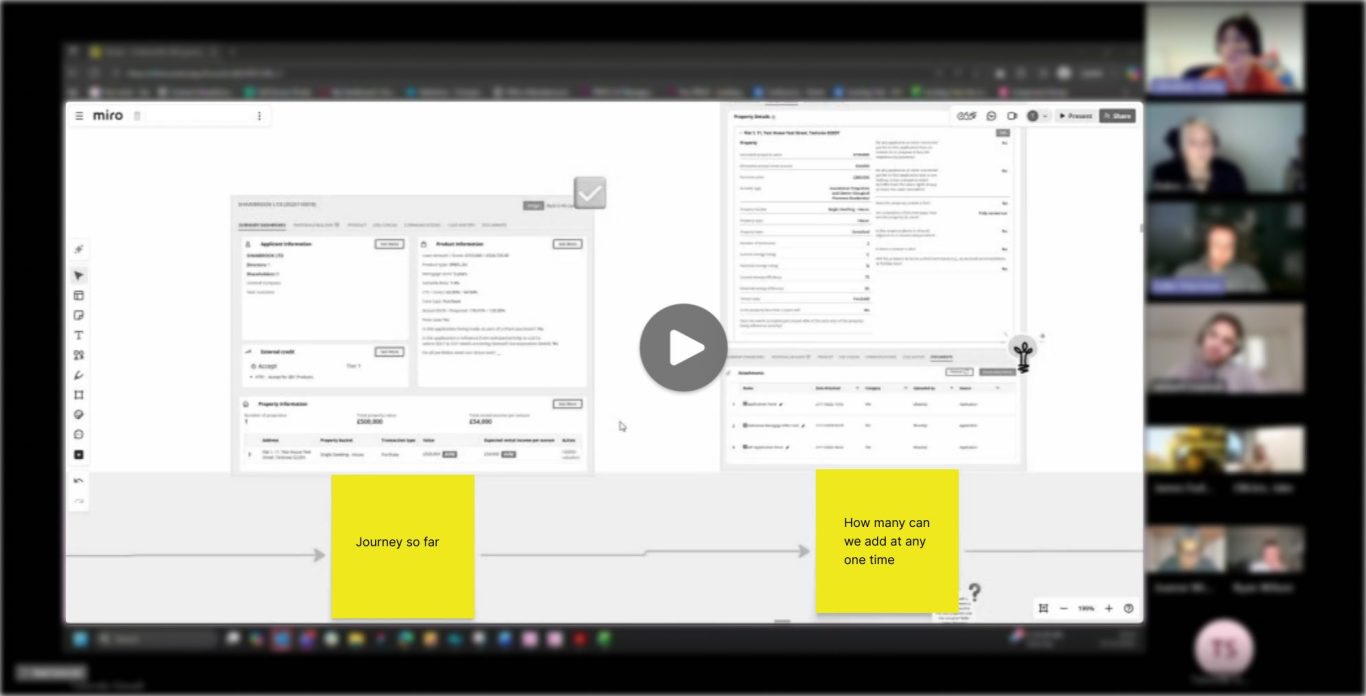
In addition, “live draw” sessions were conducted to support the visualisation process. These sessions allowed ideas to be sketched and refined in real time, helping the team quickly explore concepts and better understand both strengths and potential issues when shaping strategy and planning content.
Key focus areas
Underwriter hub is a massive piece of software due to its many sections of supporting information so comparmentalising these is essential to making the environment easy to navligate. Previous agency steer (before my involvment in the platform) put Underwriter hub on a dangerous path of becoming tab dependant so this was a starting point for exploration.
Consistency at scale
Ensures a cohesive look, feel, and behaviour across all products and touch-points. As Underwriter hub is built in Pega CMA this meeans a light touch appreach to using the design system. Colour, spacing and content design were used to convey the banks look and feel without compromising Pega's speed.
Efficiency and speed
Internal components and patterns reduced design and development time and eliminate duplicated work. Also relying on Pega's defualt components ruled out any development headaches.
Improved collaboration
Creates a shared language between designers, developers, and product teams, reducing misalignment.
Higher quality and usability
Components are already tested, refined, and accessible by default, leading to better user experiences. I could focus more on the journey.
Simplified maintenance
Updates can be made centrally and rolled out consistently, reducing technical and design debt. Also any updates to the core CMS happened through the Pega system so have little to no impact on the Underwriter hub
My role
My main roles for the development of the design system started by trying to understand the question - What is the best way to unify Shawbrook's product catalogue and create a smooth way of creating a visual language that is easily recognisable as Shawbrook. My other key roles were:
Product Designer
I designed the patterns and layouts while ensuring usability, accessibility, and consistency. I also ensured the Pega space reflected brand guidelines where possible, visual identity, and design principles. I also lent quite heavily on content design to keep the 'flavour' of the bank strong.
UX / Research
As mentioned above, twice weekly sessions with the audience along with peer reviews in the XD Team (experience design team) to keep my mind fresh and invite constructive critiques.
Accessibility
This was all about designing out the excessive tabbing and making sure users with sight problems could navigate effectively.
Product / Stakeholder Representative
Aligning with business via PMs and story slides, highlighting any product needs, and exposure across teams. A great deal of storytelling took place to make sure there were no surprises.
Timeline
Underwriter hub is an ongoing piece comprising of many iterations and larger updates. Each project focused on a section that required updating or refining inline with feedback or industry needs. These were broken into 2 week sprints of which design remained at a minimum of 3 sprints (6 weeks) ahead.
Team
I took the role of designer, researcher and storyteller. I also had a team of 6x developers divided into 2x Pega specialists plus 4x in-house devs and 2x QA members.
Problem
The problem to be solved
The Underwriter hub contains a large volume of information for underwriters to review, which can make it difficult to navigate, particularly for users who are unfamiliar with the system. Finding the right information quickly can be challenging, and this becomes especially problematic when responding to client queries that require timely answers.
A previous agency was engaged to develop early concepts and deliver an initial platform; however, the solution relied heavily on tab-based navigation. This approach proved difficult to scale and resulted in multiple pages of fragmented information, creating a complex and time-consuming user experience.
Why it matters
Processing customer data is inherently complex, and poorly structured interfaces add unnecessary friction for underwriting teams. By surfacing key information needed to make a decision—while still allowing easy access to deeper detail when required—the platform can support faster, more confident decision-making. This approach enables quicker responses, more efficient processing of deals, and a better experience for both internal teams and customers.
Approach
Always aware of Pegas limits
- Listen to our teams and understand the limits for the previous platform (BlueChip) so that we could emulate the good and remove / reduce the bad.
- Use this feedback to analyse and drive the next raft of updates / refinements.
- Review these updates with our development team and underwriters.
- Sketch and prototype to make sure we have no glaring holes in the processes.
- Communicate progress, decisions, and upcoming changes clearly and consistently across teams.
- Actively promote change and promote the new benefits.
- Watch and learn as the new systems are used.
- Continuously evolve the platform based on real-world usage, feedback, and product needs.
Solution
The Underwriter Hub has been under my design leadership for the past two years. During this time, the platform has evolved significantly and remains in active development as requirements continue to change. It is a large, task-driven system that supports both managerial overview and individual case management, enabling managers to view all cases at a high level while allowing underwriters to focus on individual applications.
These views support key workflows such as assigning cases, making referrals where required, and drilling into detailed information from both brokerage submissions and customer-specific data.
The long-term goal of the Underwriter Hub is to become fully self-reliant, reducing dependency on third-party software and progressively automating information processing to lower the workload for underwriting teams. The platform has already made strong progress toward this goal and continues to evolve through improved data quality, clearer pathways to information, and more effective communication across departments.
Impact
- 70% increase in case speed from inception to delivered product
- 35% time saved in daily processeing of tasks
- An increase of £17 million in 2024